Use Cases Of 100/16 Needle- Conquer Thick Fabric Like You Never Did
As a newbie sewer, I have ruined my fabric many times- skipped stitches, broken thread and much more. I was blaming my sewing machine but it wasn’t the problem. I discussed the issue with my sister and got to know that the needle was causing problems, not the machine.
She taught me the basics of needles including one of one most popular ones i.e. 100/16. After learning about it, I have been mindful about needle selection. I noticed a lot of people repeat the same mistake of selecting the wrong needle. So, I decided to create this short and informative post to help those who aren’t familiar with it yet.
Before I talk about the uses of this needle, you need to know why it is named 100/16.
What does 100/16 even mean?
A sewing needle contains a dual-numbering system i.e An American & European. The American number was developed by Singer and the European metric, also known as the international system, was established in 1942.
The European metric refers to the diameter of the needle in hundredths of a millimeter. For example, the size 100 means 1mm in thickness.
The American numbering uses a sequence and its actual size differs from the mentioned one. For example, 16 and 18 refers to 100 & 110 in European metrics respectively.
These are some of the common needles for sewing:
| American Size | European/ International Size | How it is mentioned |
|---|---|---|
| 8 | 60 | 8/ 60 |
| 9 | 65 | 9/ 65 |
| 10 | 70 | 10/70 |
| 11 | 75 | 11/75 |
| 12 | 80 | 12/ 80 |
| 14 | 90 | 14/ 90 |
| 16 | 100 | 16/ 100 |
| 18 | 110 | 18/ 110 |
| 20 | 120 | 20/ 120 |
Generally, If a needle has a higher number, it’ll be thicker and stronger. If you plan to sew heavy fabric, you must use this needle. For finer fabrics, you’ll need to go with lower numbers.
How can you use the 100/16 needle?
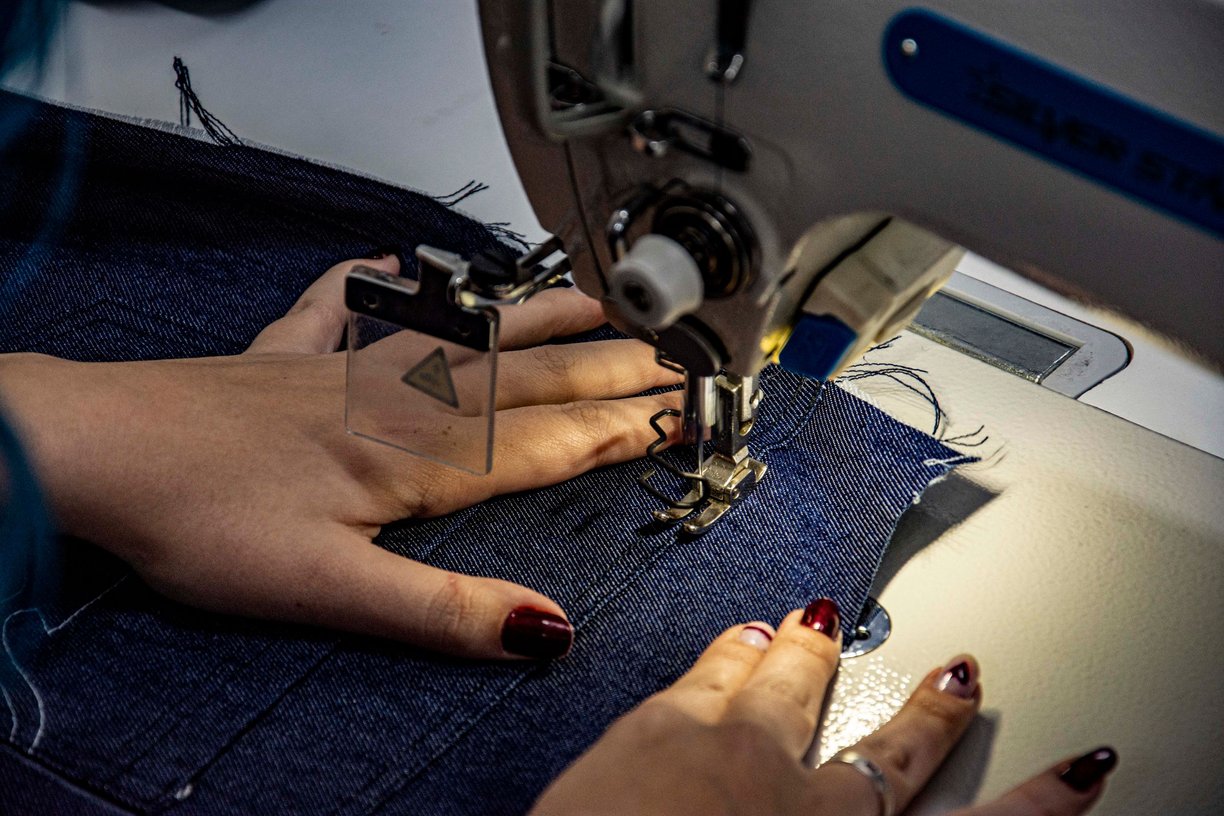
A 100/16 needle can be used to stitch heavy fabrics to pierce through multiple layers such as thicker denim, cord, heavy suiting, corduroy, velour, canvas etc. It is an ideal needle for thicker threads such as 30-weight or Tex 69 threads. Due to its thickness, it resists breaking when punching through tough materials.
When I got to know about the needle sizes, the first thing I did was stitch my jeans which I have been struggling to sew for some time. I opted for the 100/16 needle this time and was able to notice a big difference while stitching.
I wasn’t breaking or missing the threads and the fabric was in perfect condition. Since then, I’ve opted for the right needles for the right fabrics.
Not all 100/16 are same
Yes. There are different types of this needle and the most common ones are:
1. Universal Needles
This is the most common type you’ll find on most sewing machines and it comes with a starter set. It’ll have a slightly rounded tip and works well on woven fabrics, cotton, silk, and some knitting fabrics. Even though it works with most fabric types, I always ensure the needles don’t make holes unnecessarily. If it causes snugging, I just replace it with another type of needle.
2. Ballpoint Needles
The tip of this needle is more rounded than the universal one and is suitable for knitting and stretchy fabrics. For making t-shirts, tops, sweaters etc, it is my preferred choice because it slips through the fibers instead of piercing a hole.
3. Microtex Needles
These needles will have a sharp end and have a fine point and it makes it easier to pierce through the fabric. It is perfect for woven fabrics such as thin silk, chiffon, microfiber etc. Personally, I like the fine point of this needle because it lets me stitch precisely and reduce skipped stitches.
4. Stretch Needles
It features a ballpoint needle however, its eye is shorter and narrower. It is suitable for stretchy fabrics with elastic, lycra and spandex. I use it for projects such as sports bras, yoga pants, cosplay bodysuit, swimsuit etc.
FAQs
1. Which needle is the biggest- 90/14 or 100/16?
The 100/16 is the bigger one as the former is a medium-weight needle, suitable for slightly heavier weight cotton, polyester, linen, etc. For bigger projects like heavy denim, jeans, leather etc, always prefer the latter.
2. Is 100/16 good for denim?
Yes, it is a great choice for denim as the needle is capable of sewing multiple layers smoothly.
3. Which needle is thicker, 100/16 or 110/18?
The 100/18 is thicker and it is used for heavy-denim, leather, upholstery fabric, canvas, etc. If you are planning to sew such projects, choose the latter for better results.
4. What is the best needle size for sewing jeans?
1. For lightweight denim, go with the 80/12 needle.
2. For a medium-weight one, choose the 90/14 needle.
3. For heavyweight projects with thick threads, go with the 100/16 one.
4. For extremely heavy-duty projects, I suggest you go with the 110/18.
5. What is an 80/12 needle used for?
It is used for medium-weight fabrics such as quilting cotton, poplin, flannel, linen etc.
6. Can I use a 90/14 needle for jeans?
Yes. As the jeans are medium-weight denims, this needle can easily pierce through it to make perfect stitches.
Use 100/16 for the right purpose
Always use this need for heavy fabrics or the fabrics with multiple layers to get the most out of it. Don’t use it for wrong purposes like I did in my early part of the career. Let me know If you have any doubts on this topic and I’ll be happy to assist you. Cheers!